
Advertising Enters the Chat: What Brands Need to Know About Ads in ChatGPT
It’s happened.
ChatGPT ads are now in testing.
No one has ever begged for more ads. The obvious benefit of this development for consumers, as with all digital platforms that grow enough to need an ad-supported tiered offering to offset infrastructure costs, is that it will keep ChatGPT affordable. (After the eventual roll-out, ad-free tiers will remain at higher price points.)
But unlike Netflix’s “Standard with Ads” tier of programming, you won’t be seeing ads in a passive space, where ads are interspersed within content as they have been for decades. ChatGPT’s interface was specifically designed to be anthropomorphic. To feel like you’re having a conversation with a buddy. Granted, a buddy with an encyclopedic knowledge of the entirety of the internet; but it’s a conversation nonetheless.
How Do Ads Work in ChatGPT? (And Why Trust Matters)
So how will these ads work, then? No question, it’s a hugely fragile environment, and a bad ad in this environment doesn’t just miss the moment, it breaks trust.
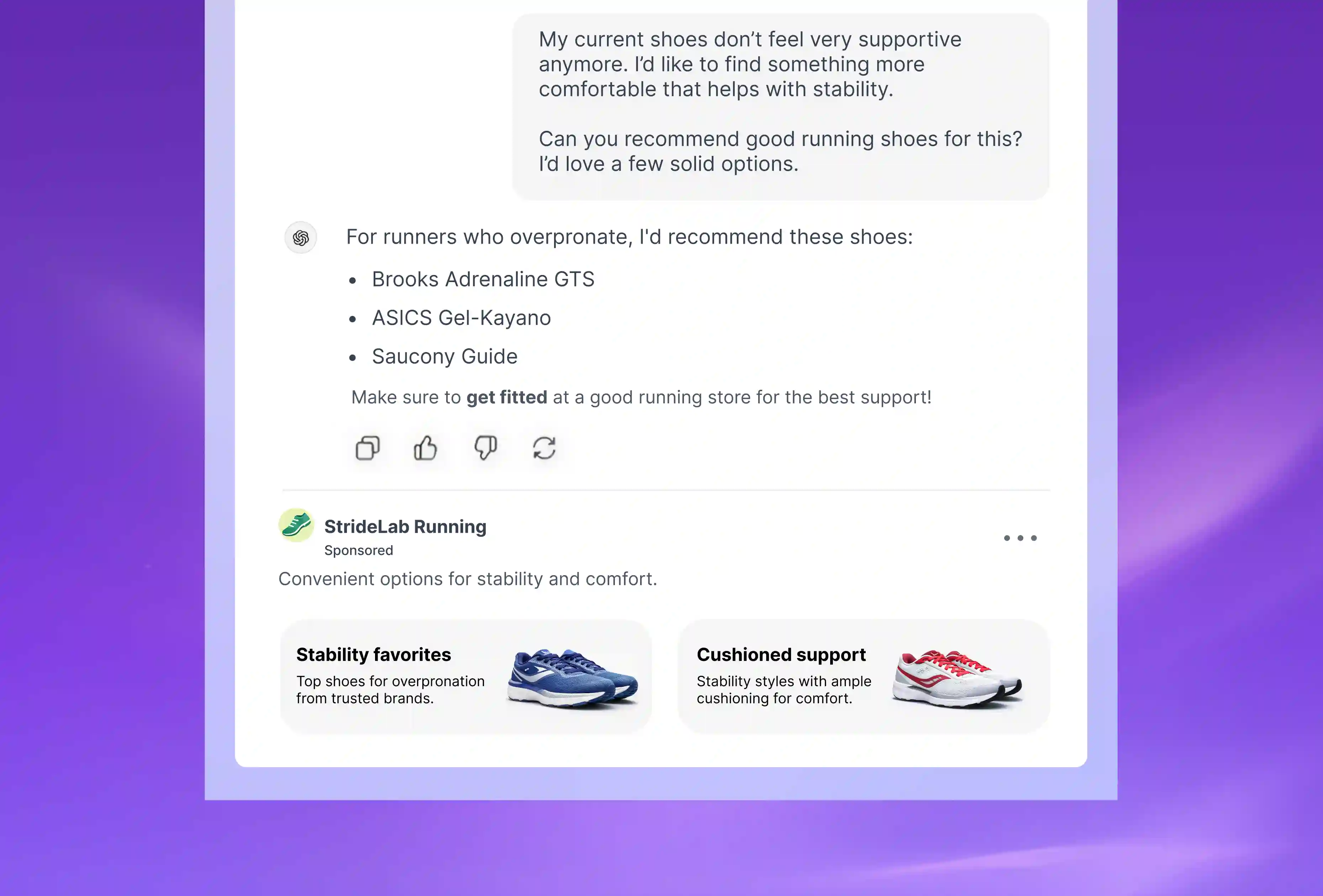
The opportunity, then, is not to insert brand messaging into the answer itself. It is to place a clearly labeled commercial message adjacent to the answer when it is genuinely relevant to what the user is trying to do. That is a much higher bar than traditional digital advertising, but it is also what makes the channel impactful. Done correctly, these ads offer major benefits for consumers and advertisers alike.
Imagine you’re at a dinner party. You end up sitting by your friend who is a big runner. As luck would have it, you’re training for your first marathon. You ask your friend for guidance on the best running shoes for people who pronate. Not only do they give you recommendations, but they then say, “By the way, I actually have a coupon for the running store, if you want it?”
This is exactly the benefit of advertising on ChatGPT. Ads perfectly align with the context of the conversation in a way that’s beneficial to the user.
Implementing Guardrails
Of course, that level of relevance comes with obvious questions, which is why OpenAI has put unusually explicit guardrails around the early test.
Ads do not influence answers and run on separate systems. They appear below the response, are clearly labeled as sponsored, and are visually separated from the organic answer. Advertisers do not receive chats, chat history, memories, or personal details; they receive aggregated performance reporting such as views and clicks.
At the same time, relevance does not come from nowhere. OpenAI says ads are matched to the current chat thread and, if personalized ads are enabled, may also use past chats and ad interactions to improve relevance over time. That information stays inside ChatGPT rather than being shared with advertisers.
The company has also limited where ads can appear and are shown to select users. During the current test, ads do not appear in Temporary Chats, when users are logged out, after image generation, or in the ChatGPT Atlas browser. Ads are not eligible to appear near sensitive or regulated topics such as health, mental health, or politics, and advertisers in sensitive verticals such as dating, health, financial services, and politics are excluded for now.
Users also retain meaningful control. They can dismiss ads, see why an ad was shown, clear ad data, and manage ad personalization settings. And people who want to avoid ads can use ad-free paid tiers or, where available, a more limited no-ads free option.
Compared with traditional digital advertising, this is a much more constrained model. It is less a broad ad launch than a tightly managed product test. They’re also testing the system first and will adjust it based on user feedback before expanding it.
The Opportunity in Advertising on ChatGPT
But ChatGPT presents a huge opportunity for advertisers in that it’s a one-to-one interaction where ads are contextual and matched to the topic of the conversation. (Again, conversations themselves and personal user data won’t be shared with advertisers, and user data isn’t sold to advertisers.) While general personalization exists across the digital ecosphere, few channels approach this level of potential relevance
But as Stan Lee taught us, “With great power comes great responsibility.” Even with guardrails, there will be increased pressure on advertisers to “get it right” in this environment. They won’t just need advanced tools to navigate this — it’s more critical than ever they have the right cutting-edge tools. Conversational AI ads introduce new and evolving challenges:
- Ads must match the context of the conversation.
- Messaging will need to be dynamic and adapt to the context of the user’s conversation.
- Creative must adapt to a wide variety of topics.
Smartly Makes it Easy
Smartly is designed for exactly these types of environments, which is why Smartly is OpenAI’s first adtech partner focused on improving how ads appear to users. Success in conversational environments depends heavily on creative adaptability and message variation, not just targeting.
In a setting like ChatGPT — where ads need to align with the context of the conversation — brands must be able to generate, test, and optimize many variations of messaging quickly. Smartly’s strength lies in helping advertisers create and manage dynamic creative at scale. It automatically produces different versions of ad copy, visuals, and formats that can match different conversational contexts and continuously improve based on performance.
While other platforms might excel at basic performance targeting and retargeting using commerce data, LLM environments shift more of the competitive advantage toward Smartly that can combine creative orchestration, media signals, and rapid iteration. Not that platforms are mutually exclusive, but for an environment as fragile as LLMs, Smartly becomes indispensable.
Done thoughtfully, conversational advertising offers a powerful opportunity: ads that are contextually relevant to what a user is actively discussing, creating a level of relevance traditional digital advertising rarely achieves. But for enterprise marketers facing the accountability of navigating this environment, the right ad tech partner is essential for making measurable but meaningful connections.
Frequently Asked Questions About ChatGPT Ads
Do ads influence ChatGPT answers?
No. Ads are served separately and do not affect the content of AI-generated responses.
How are ads targeted in ChatGPT?
Ads are matched to the context of the conversation and may use aggregated interaction data for relevance.
What makes conversational ads different?
They are context-aware, dynamically generated, and aligned to user intent in real time.
Advertising Enters the Chat: What Brands Need to Know About Ads in ChatGPT

It’s happened.
ChatGPT ads are now in testing.
No one has ever begged for more ads. The obvious benefit of this development for consumers, as with all digital platforms that grow enough to need an ad-supported tiered offering to offset infrastructure costs, is that it will keep ChatGPT affordable. (After the eventual roll-out, ad-free tiers will remain at higher price points.)
But unlike Netflix’s “Standard with Ads” tier of programming, you won’t be seeing ads in a passive space, where ads are interspersed within content as they have been for decades. ChatGPT’s interface was specifically designed to be anthropomorphic. To feel like you’re having a conversation with a buddy. Granted, a buddy with an encyclopedic knowledge of the entirety of the internet; but it’s a conversation nonetheless.
How Do Ads Work in ChatGPT? (And Why Trust Matters)
So how will these ads work, then? No question, it’s a hugely fragile environment, and a bad ad in this environment doesn’t just miss the moment, it breaks trust.
The opportunity, then, is not to insert brand messaging into the answer itself. It is to place a clearly labeled commercial message adjacent to the answer when it is genuinely relevant to what the user is trying to do. That is a much higher bar than traditional digital advertising, but it is also what makes the channel impactful. Done correctly, these ads offer major benefits for consumers and advertisers alike.
Imagine you’re at a dinner party. You end up sitting by your friend who is a big runner. As luck would have it, you’re training for your first marathon. You ask your friend for guidance on the best running shoes for people who pronate. Not only do they give you recommendations, but they then say, “By the way, I actually have a coupon for the running store, if you want it?”
This is exactly the benefit of advertising on ChatGPT. Ads perfectly align with the context of the conversation in a way that’s beneficial to the user.
Implementing Guardrails
Of course, that level of relevance comes with obvious questions, which is why OpenAI has put unusually explicit guardrails around the early test.
Ads do not influence answers and run on separate systems. They appear below the response, are clearly labeled as sponsored, and are visually separated from the organic answer. Advertisers do not receive chats, chat history, memories, or personal details; they receive aggregated performance reporting such as views and clicks.
At the same time, relevance does not come from nowhere. OpenAI says ads are matched to the current chat thread and, if personalized ads are enabled, may also use past chats and ad interactions to improve relevance over time. That information stays inside ChatGPT rather than being shared with advertisers.
The company has also limited where ads can appear and are shown to select users. During the current test, ads do not appear in Temporary Chats, when users are logged out, after image generation, or in the ChatGPT Atlas browser. Ads are not eligible to appear near sensitive or regulated topics such as health, mental health, or politics, and advertisers in sensitive verticals such as dating, health, financial services, and politics are excluded for now.
Users also retain meaningful control. They can dismiss ads, see why an ad was shown, clear ad data, and manage ad personalization settings. And people who want to avoid ads can use ad-free paid tiers or, where available, a more limited no-ads free option.
Compared with traditional digital advertising, this is a much more constrained model. It is less a broad ad launch than a tightly managed product test. They’re also testing the system first and will adjust it based on user feedback before expanding it.
The Opportunity in Advertising on ChatGPT
But ChatGPT presents a huge opportunity for advertisers in that it’s a one-to-one interaction where ads are contextual and matched to the topic of the conversation. (Again, conversations themselves and personal user data won’t be shared with advertisers, and user data isn’t sold to advertisers.) While general personalization exists across the digital ecosphere, few channels approach this level of potential relevance
But as Stan Lee taught us, “With great power comes great responsibility.” Even with guardrails, there will be increased pressure on advertisers to “get it right” in this environment. They won’t just need advanced tools to navigate this — it’s more critical than ever they have the right cutting-edge tools. Conversational AI ads introduce new and evolving challenges:
- Ads must match the context of the conversation.
- Messaging will need to be dynamic and adapt to the context of the user’s conversation.
- Creative must adapt to a wide variety of topics.
Smartly Makes it Easy
Smartly is designed for exactly these types of environments, which is why Smartly is OpenAI’s first adtech partner focused on improving how ads appear to users. Success in conversational environments depends heavily on creative adaptability and message variation, not just targeting.
In a setting like ChatGPT — where ads need to align with the context of the conversation — brands must be able to generate, test, and optimize many variations of messaging quickly. Smartly’s strength lies in helping advertisers create and manage dynamic creative at scale. It automatically produces different versions of ad copy, visuals, and formats that can match different conversational contexts and continuously improve based on performance.
While other platforms might excel at basic performance targeting and retargeting using commerce data, LLM environments shift more of the competitive advantage toward Smartly that can combine creative orchestration, media signals, and rapid iteration. Not that platforms are mutually exclusive, but for an environment as fragile as LLMs, Smartly becomes indispensable.
Done thoughtfully, conversational advertising offers a powerful opportunity: ads that are contextually relevant to what a user is actively discussing, creating a level of relevance traditional digital advertising rarely achieves. But for enterprise marketers facing the accountability of navigating this environment, the right ad tech partner is essential for making measurable but meaningful connections.
Frequently Asked Questions About ChatGPT Ads
Do ads influence ChatGPT answers?
No. Ads are served separately and do not affect the content of AI-generated responses.
How are ads targeted in ChatGPT?
Ads are matched to the context of the conversation and may use aggregated interaction data for relevance.
What makes conversational ads different?
They are context-aware, dynamically generated, and aligned to user intent in real time.


Honestly, we'd rather just show you.
Chat with our team to see how Smartly transforms the fragmented advertising ecosystem into something suspiciously manageable.


%201%20(1)%201%201.avif)

