
Creative Intelligence: How to Turn Creative Into a Measurable Performance Driver
Creative is no longer a fixed, upstream input to marketing performance. According to new research from Winterberry Group, it has become something far more powerful: a measurable, optimizable lever that directly influences outcomes across the funnel.
That shift is already underway. What’s changing now is expectations.
High-performing teams are no longer satisfied with understanding why creative works after a campaign ends. They need to know what will work before launch, what to optimize in-flight, and how creative performance should influence media decisions in real time.
This is the promise of creative intelligence, and it’s quickly becoming table stakes.
But insight alone isn’t enough. Creative intelligence only delivers value when it can be operationalized.
What is Creative Intelligence?
Creative intelligence is the ability to measure, predict, and optimize ad creative performance using data, analytics, and automation across the entire campaign lifecycle—from pre-launch testing to in-flight optimization and post-campaign learning.
Winterberry Group defines creative intelligence as a full-lifecycle capability, not a point solution. And we agree, it’s not just the top of funnel, creative intelligence powers the full funnel.
Their framework spans creative ingestion, analytics, pre-testing, activation, optimization, and measurement—connecting development, delivery, and learning into a single operating model.
Crucially, the research shows that demand is being driven by actionable optimization, not retrospective reporting. Brands want to predict performance before launch, optimize during campaigns, and isolate creative’s true contribution to outcomes.
This isn’t a future-state vision. It’s how leading teams are already operating.
Why is Creative Intelligence Critical for Performance Marketing Today?
For years, marketing optimization focused almost exclusively on media and audience data. Creative was treated as a necessary input—important, but largely static once campaigns went live.
That model no longer holds.
Winterberry Group’s research report “Demystifying Creative Intelligence” shows that creative optimization is already the top priority for brands today. In fact, 31% of respondents say Creative optimization is their leading focus for improving advertising effectiveness. Personalization follows closely behind. Both reinforce that creative decisions are now central to performance—not decorative around it.
Creative intelligence reframes creative as a dynamic system. It brings together creative data, analytics, activation, and measurement to help teams understand not just how ads perform, but why—and to apply those learnings continuously.
In other words, creative has moved from a cost center to a performance driver.
The challenge is that many organizations still experience creative intelligence as disconnected pieces: insights trapped in dashboards, testing that happens too late, optimization that favors media signals alone, and learning cycles that move more slowly than the market demands.
That gap between insight and action is where performance breaks down.
Why Do Most Creative Intelligence Programs Fail?
Despite growing investment in creative data and analytics, many teams still struggle to operationalize what they learn.
Creative insights live in one place. Media execution lives in another. Optimization decisions happen too late—or without creative context.
The result is familiar:
- Creative teams can’t act quickly enough on performance signals
- Media teams optimize delivery without confidence if the creative will perform
- Learning loops are slow, fragmented, or lost entirely
Creative intelligence only works when insight and execution are tightly connected.
That’s where the Smartly Creative Suite comes in.
How Does Smartly Operationalize Creative Intelligence?
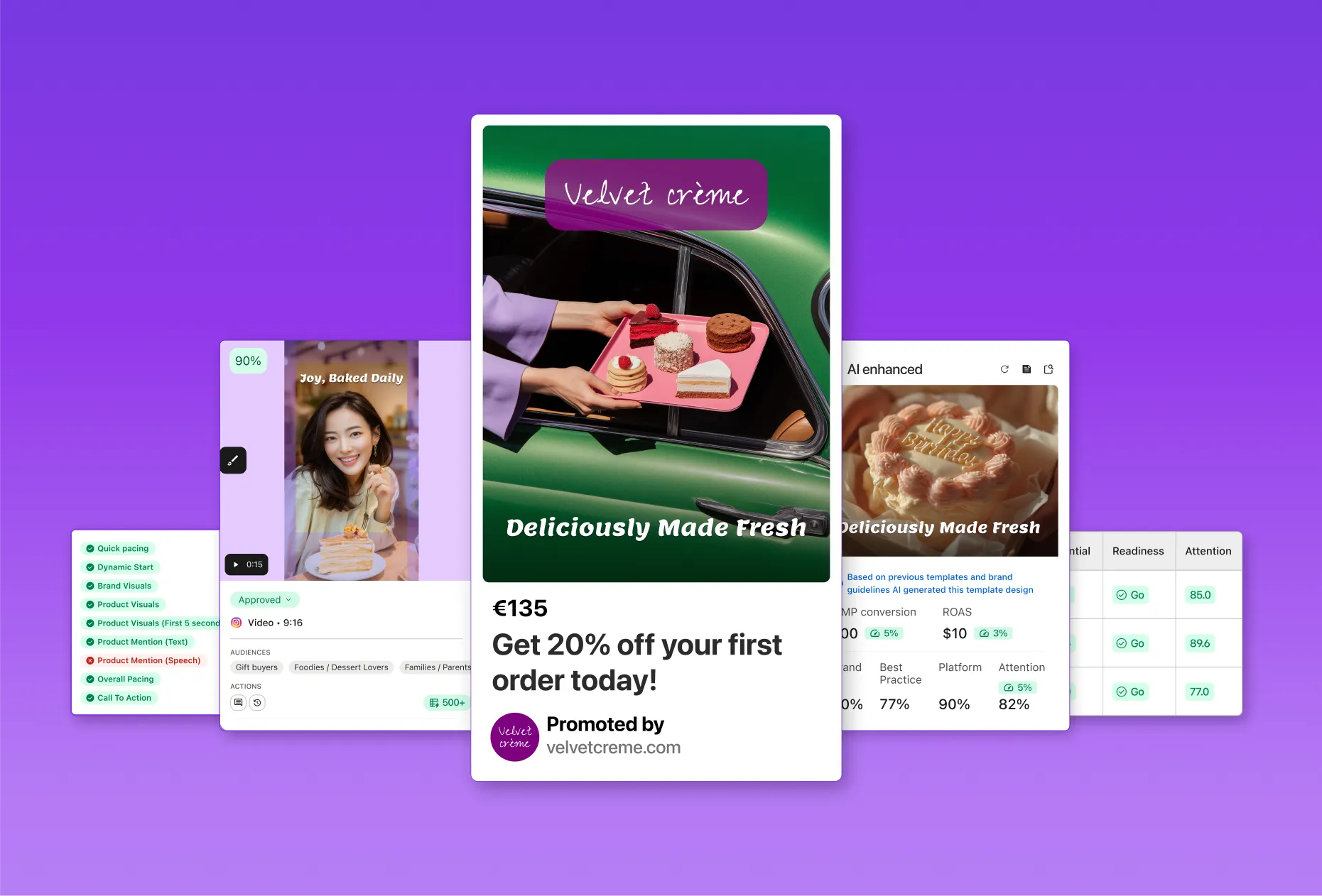
Smartly Creative Suite is designed to make creative intelligence actionable—not as a collection of tools, but as an operational system that connects creative, media, and measurement across the full lifecycle.
The same framework Winterberry Group outlines is already embedded into how Creative Suite works today.
Creative data ingestion and analysis
Creative Suite ingests assets across formats and channels, normalizing creative data at the asset level. Performance is analyzed alongside media signals, giving teams a clear view of how creative elements influence outcomes—not in isolation, but in context.
This foundation enables Creative Insights to surface patterns across imagery, video, copy, and structure, turning raw creative data into usable intelligence.
Pre-testing and predictive scoring
Rather than waiting for performance after launch, Creative Suite supports pre-testing and predictive evaluation before committing media dollars.
This matters because Winterberry’s research shows pre-testing is one of the fastest-rising priorities, expected to be a top use case for 18% of organizations within the next 18 months, nearly doubling its importance compared to today.
Attention, sentiment, and performance signals help teams assess creative effectiveness early—reducing wasted production and enabling smarter investment decisions.
Modular and intelligent creative
Creative Suite powers modular, intelligent creative that scales what works without sacrificing brand consistency.
By enabling component-level variation, teams can adapt creative based on performance signals instead of rebuilding assets from scratch. This moves organizations beyond static versions toward systems that learn and improve over time.
In-flight optimization tied to media signals
Creative intelligence doesn’t stop at launch.
During live campaigns, Creative Suite enables in-flight optimization tied directly to media delivery signals. Underperforming assets can be deprioritized, high performers scaled, and creative fatigue managed proactively.
This alignment matters as Winterberry Group finds that creative optimization and personalization are expected to be tied as the top priorities within 18 months, each cited by 23% of respondents—signaling that performance teams expect creative and media decisions to move together, not sequentially.
Closing the loop between creative and activation
Perhaps most importantly, Creative Suite closes the loop.
Performance insights feed back into production, planning, and future strategy. Teams build institutional knowledge instead of one-off wins. Creative becomes a continuously improving system, not a series of disconnected campaigns.
Creative Intelligence Across the Full Lifecycle
The Winterberry Group report makes clear that creative intelligence delivers value at every stage of the creative lifecycle—and Creative Suite is built to support all of them.
Before launch
- Smarter briefs informed by historical performance
- Predictive signals guide creative and media investment decisions
In flight
- Continuous optimization replaces episodic reviews
- Creative and media operate in sync
After launch
- Asset- and campaign-level measurement
- Creative contribution quantified, not assumed
This closed-loop system is what allows creative to function as a true performance lever.
Why This is Now Critical for Performance Marketing
According to the research, adoption of creative intelligence is accelerating rapidly. Investment is growing, use cases are expanding, and responsibility for creative performance is converging with media accountability.
In fact, creative intelligence–powered creative spend is projected to grow at roughly 23% CAGR through 2028, reaching nearly $11.5B—a clear signal that this shift is structural, not experimental.
Teams that can operationalize creative intelligence will move faster, waste less, and learn more.
Teams that can’t will struggle to keep up.
Creative intelligence is no longer experimental. It’s infrastructure.
The Takeaway
Most teams already know the power of more information, earlier. The real challenge is making creative intelligence actionable.
Smartly Creative Suite is built to do exactly that—turning creative intelligence into outcomes by connecting creative production, pre-testing, activation, optimization, and measurement in one system.
Creative and media are no longer separate disciplines. Creative Suite is designed for the way performance marketing works now.
Power better ads by design, not by chance. See how with Smartly.
Creative Intelligence: How to Turn Creative Into a Measurable Performance Driver


Creative is no longer a fixed, upstream input to marketing performance. According to new research from Winterberry Group, it has become something far more powerful: a measurable, optimizable lever that directly influences outcomes across the funnel.
That shift is already underway. What’s changing now is expectations.
High-performing teams are no longer satisfied with understanding why creative works after a campaign ends. They need to know what will work before launch, what to optimize in-flight, and how creative performance should influence media decisions in real time.
This is the promise of creative intelligence, and it’s quickly becoming table stakes.
But insight alone isn’t enough. Creative intelligence only delivers value when it can be operationalized.
What is Creative Intelligence?
Creative intelligence is the ability to measure, predict, and optimize ad creative performance using data, analytics, and automation across the entire campaign lifecycle—from pre-launch testing to in-flight optimization and post-campaign learning.
Winterberry Group defines creative intelligence as a full-lifecycle capability, not a point solution. And we agree, it’s not just the top of funnel, creative intelligence powers the full funnel.
Their framework spans creative ingestion, analytics, pre-testing, activation, optimization, and measurement—connecting development, delivery, and learning into a single operating model.
Crucially, the research shows that demand is being driven by actionable optimization, not retrospective reporting. Brands want to predict performance before launch, optimize during campaigns, and isolate creative’s true contribution to outcomes.
This isn’t a future-state vision. It’s how leading teams are already operating.
Why is Creative Intelligence Critical for Performance Marketing Today?
For years, marketing optimization focused almost exclusively on media and audience data. Creative was treated as a necessary input—important, but largely static once campaigns went live.
That model no longer holds.
Winterberry Group’s research report “Demystifying Creative Intelligence” shows that creative optimization is already the top priority for brands today. In fact, 31% of respondents say Creative optimization is their leading focus for improving advertising effectiveness. Personalization follows closely behind. Both reinforce that creative decisions are now central to performance—not decorative around it.
Creative intelligence reframes creative as a dynamic system. It brings together creative data, analytics, activation, and measurement to help teams understand not just how ads perform, but why—and to apply those learnings continuously.
In other words, creative has moved from a cost center to a performance driver.
The challenge is that many organizations still experience creative intelligence as disconnected pieces: insights trapped in dashboards, testing that happens too late, optimization that favors media signals alone, and learning cycles that move more slowly than the market demands.
That gap between insight and action is where performance breaks down.
Why Do Most Creative Intelligence Programs Fail?
Despite growing investment in creative data and analytics, many teams still struggle to operationalize what they learn.
Creative insights live in one place. Media execution lives in another. Optimization decisions happen too late—or without creative context.
The result is familiar:
- Creative teams can’t act quickly enough on performance signals
- Media teams optimize delivery without confidence if the creative will perform
- Learning loops are slow, fragmented, or lost entirely
Creative intelligence only works when insight and execution are tightly connected.
That’s where the Smartly Creative Suite comes in.
How Does Smartly Operationalize Creative Intelligence?
Smartly Creative Suite is designed to make creative intelligence actionable—not as a collection of tools, but as an operational system that connects creative, media, and measurement across the full lifecycle.
The same framework Winterberry Group outlines is already embedded into how Creative Suite works today.
Creative data ingestion and analysis
Creative Suite ingests assets across formats and channels, normalizing creative data at the asset level. Performance is analyzed alongside media signals, giving teams a clear view of how creative elements influence outcomes—not in isolation, but in context.
This foundation enables Creative Insights to surface patterns across imagery, video, copy, and structure, turning raw creative data into usable intelligence.
Pre-testing and predictive scoring
Rather than waiting for performance after launch, Creative Suite supports pre-testing and predictive evaluation before committing media dollars.
This matters because Winterberry’s research shows pre-testing is one of the fastest-rising priorities, expected to be a top use case for 18% of organizations within the next 18 months, nearly doubling its importance compared to today.
Attention, sentiment, and performance signals help teams assess creative effectiveness early—reducing wasted production and enabling smarter investment decisions.
Modular and intelligent creative
Creative Suite powers modular, intelligent creative that scales what works without sacrificing brand consistency.
By enabling component-level variation, teams can adapt creative based on performance signals instead of rebuilding assets from scratch. This moves organizations beyond static versions toward systems that learn and improve over time.
In-flight optimization tied to media signals
Creative intelligence doesn’t stop at launch.
During live campaigns, Creative Suite enables in-flight optimization tied directly to media delivery signals. Underperforming assets can be deprioritized, high performers scaled, and creative fatigue managed proactively.
This alignment matters as Winterberry Group finds that creative optimization and personalization are expected to be tied as the top priorities within 18 months, each cited by 23% of respondents—signaling that performance teams expect creative and media decisions to move together, not sequentially.
Closing the loop between creative and activation
Perhaps most importantly, Creative Suite closes the loop.
Performance insights feed back into production, planning, and future strategy. Teams build institutional knowledge instead of one-off wins. Creative becomes a continuously improving system, not a series of disconnected campaigns.
Creative Intelligence Across the Full Lifecycle
The Winterberry Group report makes clear that creative intelligence delivers value at every stage of the creative lifecycle—and Creative Suite is built to support all of them.
Before launch
- Smarter briefs informed by historical performance
- Predictive signals guide creative and media investment decisions
In flight
- Continuous optimization replaces episodic reviews
- Creative and media operate in sync
After launch
- Asset- and campaign-level measurement
- Creative contribution quantified, not assumed
This closed-loop system is what allows creative to function as a true performance lever.
Why This is Now Critical for Performance Marketing
According to the research, adoption of creative intelligence is accelerating rapidly. Investment is growing, use cases are expanding, and responsibility for creative performance is converging with media accountability.
In fact, creative intelligence–powered creative spend is projected to grow at roughly 23% CAGR through 2028, reaching nearly $11.5B—a clear signal that this shift is structural, not experimental.
Teams that can operationalize creative intelligence will move faster, waste less, and learn more.
Teams that can’t will struggle to keep up.
Creative intelligence is no longer experimental. It’s infrastructure.
The Takeaway
Most teams already know the power of more information, earlier. The real challenge is making creative intelligence actionable.
Smartly Creative Suite is built to do exactly that—turning creative intelligence into outcomes by connecting creative production, pre-testing, activation, optimization, and measurement in one system.
Creative and media are no longer separate disciplines. Creative Suite is designed for the way performance marketing works now.
Power better ads by design, not by chance. See how with Smartly.


Honestly, we'd rather just show you.
Chat with our team to see how Smartly transforms the fragmented advertising ecosystem into something suspiciously manageable.




%201%20(1)%201%201.avif)

