The Agentic Era Is a Test of Human Judgment
AI is already part of marketers’ work. The harder question is what teams should trust it to do and where human judgment still needs to lead.
At ADVANCE 2026, Smartly CEO Laura Desmond described the shift this way: “It has moved beyond adoption.” New Smartly research, conducted by Alter Agents among 500 marketers, points to what comes next: using AI at scale while keeping people responsible for the choices that shape a brand.
Nearly every marketer surveyed uses AI for work. Now, organizations need to define how to put that capability to work without giving up the judgment and creative direction that makes marketing matter.
Today, as AI achieves ubiquity at work, the conversation shifts from adoption to application. As marketing evolves, uniquely human skills like creative brainstorming and strategic planning are even more critical, with 95% of marketers actively seeking training in these areas.
AI adoption is the starting point
Marketers are optimistic about what AI technology can unlock. In the study, 81% say AI enables them to bring bigger projects and ideas to life than they could on their own. At the same time, 67% agree that AI will inevitably replace certain marketing roles. These findings can coexist: AI expands an individual’s reach while changing the shape of work and the skills teams need.
Knowing that AI opens doors for marketers, the question becomes: what skills are needed for the next generation of marketers, how are marketing organizations evolving, and how AI can be used responsibly to drive better outcomes for both brands and consumers?
Marketing roles won't be replaced, but they will be transformed. Marketers recognize the opportunity for human-driven scale when AI is used responsibly. AI serves as an efficiency tool that empowers human ingenuity, oversight, and brand creativity. However, the power of that tool is dependent on the inputs it receives.
Scale needs a point of view
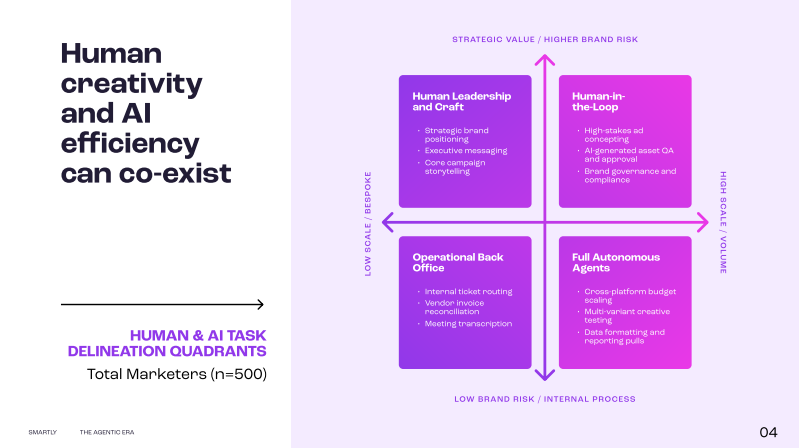
We can evaluate AI’s potential by looking at the relationship between strategic value and brand risk vs. volume and scalability. Nevertheless, the value of AI tooling and its most advantageous use cases, will depend on the circumstance in which it's being leveraged.
For example, where AI has the biggest opportunity to provide impact at scale with the lowest risk to the brand is by leveraging agents for largely backend processes like cross platform budget scaling, multivariate creative testing, and data processing or formatting and reporting pulls. In this sense, we can see AI as an always on execution partner running in the background for work streams that don't pose a public-facing risk to brand identity.
However, we also know that 99% of marketers use AI today and not all of them are touching these backend work streams. That begs the next logical question: How are marketers using AI in their day-to-day workflows across differing use cases like media planning and creative and marketing intelligence, and where are the opportunity areas for operationalizing AI workflows at the organizational level?
For brand strategists, for example, full autonomous agents to generate new creative concepts are not a possibility, nor should they be. Rather, for marketers crafting distinct brand voices, creatives and holistic brand strategies, human leadership and craft remain essential. Strategic brand positioning, storytelling and executive messaging should remain under human leadership and craft almost exclusively, while certain offshoots of these bigger blocks can be templated and then run through AI for scaled automation, but with strategic oversight.
What does this mean for the future of marketing?
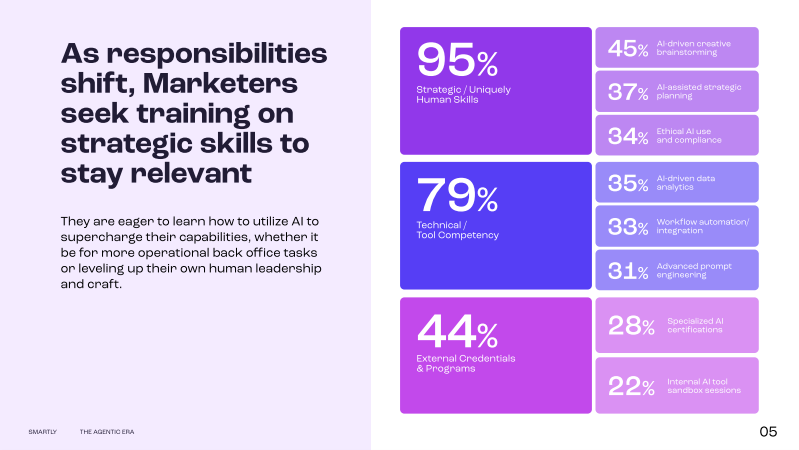
It means that uniquely human skills like relationship management, creative brainstorming, and the adhering to brand governance and guardrailing best practices will become an imperative to success in the future. Today’s marketers know this and are eager to learn how to utilize AI to supercharge their capabilities, with 95% seeking continuous training and improvement in strategic or uniquely human skills like AI-driven creative brainstorming (45%), strategic planning (37%), and ethical governance (34%).
With strategic upskilling highly sought-after across levels, this also poses a significant question for how role-progression might look among junior marketers moving forward. Historically, task-based work–now automatable–served a critical role in building marketer skill-sets through learned experience and many are left wondering how junior marketers will acquire the tools necessary for strategic oversight.
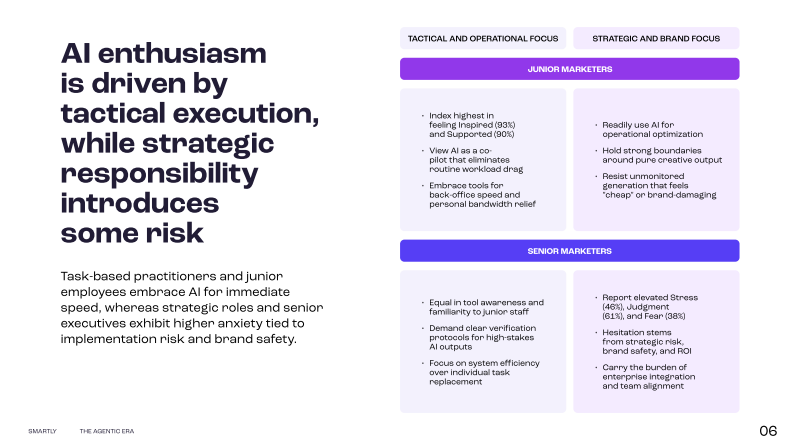
Today, much of that anxiety is projected. Task-based practitioners and junior employees embrace AI for immediate speed, viewing it as a co-pilot that eliminates routine workload drag. They emphasized feeling inspired (93%) and supported (90%), readily using AI for operational optimization and back-office tasks while maintaining strong boundaries against unmonitored generation that feels "cheap" or brand-damaging.
In contrast, strategic roles and senior executives exhibit higher anxiety tied to implementation risk, brand safety, and ROI. While equal in tool awareness and familiarity to junior staff, senior marketers report elevated stress (46%), judgment (61%), and fear (38%). They demand clear verification protocols for high-stakes AI outputs and focus on overall system efficiency over individual task replacement, bearing the primary burden of enterprise integration and team alignment.
The modern marketer’s AI toolkit
For AI companies and power users alike, the obvious opportunity lies in shifting messaging from task replacement to skill elevation and governance. Effectively leveraging AI to get the most out of your marketing requires navigating obstacles to adoption, as well as accounting for potential red flags associated with brand-risk and a flattening of creative voice.
Then, scaling AI requires establishing a roadmap—balancing AI’s strengths in rapid asset variation and cross-functional reach against opportunistic human oversight to prevent generic output, preserve cultural nuance, and protect brand equity.
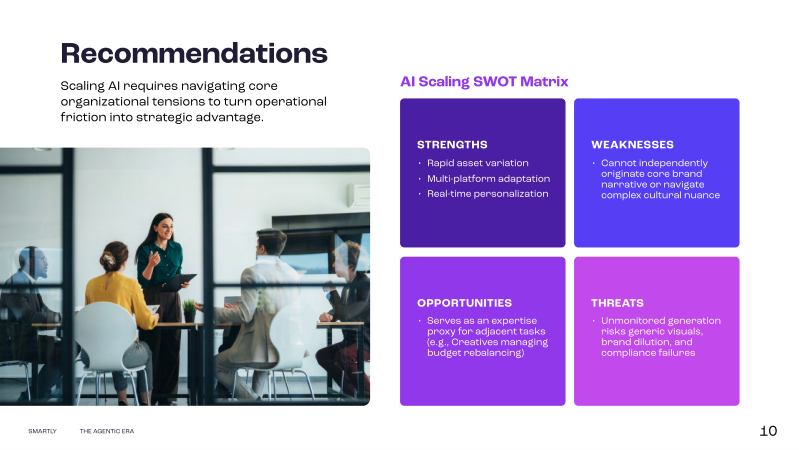
- Deploy Human-in-the-Loop: Architect clear task delineations. Delegate operational tasks like budget rebalancing and reporting to autonomous agents, while embedding human final approval on creative outputs.
- Elevate Strategic Skills: Position AI as a skill-elevating co-pilot. Reinvest saved time into upskilling teams on brand stewardship, market intelligence, and long-term strategy, addressing the 95% of marketers seeking training in uniquely human skills. This will also supplement more junior marketers with the skill-based training they’ll need for their own career trajectories.
- Mitigate Senior Hesitation with Stronger Governance: Address leadership risk by leading executive messaging with brand-safety guardrails, verification protocols, and risk governance. Frame AI as an enterprise operating system that protects brand equity while driving scale.
Download the full report for even more insights on the agentic era and how marketers can put them into action.

AI is already part of marketers’ work. The harder question is what teams should trust it to do and where human judgment still needs to lead.
At ADVANCE 2026, Smartly CEO Laura Desmond described the shift this way: “It has moved beyond adoption.” New Smartly research, conducted by Alter Agents among 500 marketers, points to what comes next: using AI at scale while keeping people responsible for the choices that shape a brand.
Nearly every marketer surveyed uses AI for work. Now, organizations need to define how to put that capability to work without giving up the judgment and creative direction that makes marketing matter.
Today, as AI achieves ubiquity at work, the conversation shifts from adoption to application. As marketing evolves, uniquely human skills like creative brainstorming and strategic planning are even more critical, with 95% of marketers actively seeking training in these areas.
AI adoption is the starting point
Marketers are optimistic about what AI technology can unlock. In the study, 81% say AI enables them to bring bigger projects and ideas to life than they could on their own. At the same time, 67% agree that AI will inevitably replace certain marketing roles. These findings can coexist: AI expands an individual’s reach while changing the shape of work and the skills teams need.
Knowing that AI opens doors for marketers, the question becomes: what skills are needed for the next generation of marketers, how are marketing organizations evolving, and how AI can be used responsibly to drive better outcomes for both brands and consumers?
Marketing roles won't be replaced, but they will be transformed. Marketers recognize the opportunity for human-driven scale when AI is used responsibly. AI serves as an efficiency tool that empowers human ingenuity, oversight, and brand creativity. However, the power of that tool is dependent on the inputs it receives.
Scale needs a point of view
We can evaluate AI’s potential by looking at the relationship between strategic value and brand risk vs. volume and scalability. Nevertheless, the value of AI tooling and its most advantageous use cases, will depend on the circumstance in which it's being leveraged.
For example, where AI has the biggest opportunity to provide impact at scale with the lowest risk to the brand is by leveraging agents for largely backend processes like cross platform budget scaling, multivariate creative testing, and data processing or formatting and reporting pulls. In this sense, we can see AI as an always on execution partner running in the background for work streams that don't pose a public-facing risk to brand identity.
However, we also know that 99% of marketers use AI today and not all of them are touching these backend work streams. That begs the next logical question: How are marketers using AI in their day-to-day workflows across differing use cases like media planning and creative and marketing intelligence, and where are the opportunity areas for operationalizing AI workflows at the organizational level?
For brand strategists, for example, full autonomous agents to generate new creative concepts are not a possibility, nor should they be. Rather, for marketers crafting distinct brand voices, creatives and holistic brand strategies, human leadership and craft remain essential. Strategic brand positioning, storytelling and executive messaging should remain under human leadership and craft almost exclusively, while certain offshoots of these bigger blocks can be templated and then run through AI for scaled automation, but with strategic oversight.
What does this mean for the future of marketing?
It means that uniquely human skills like relationship management, creative brainstorming, and the adhering to brand governance and guardrailing best practices will become an imperative to success in the future. Today’s marketers know this and are eager to learn how to utilize AI to supercharge their capabilities, with 95% seeking continuous training and improvement in strategic or uniquely human skills like AI-driven creative brainstorming (45%), strategic planning (37%), and ethical governance (34%).
With strategic upskilling highly sought-after across levels, this also poses a significant question for how role-progression might look among junior marketers moving forward. Historically, task-based work–now automatable–served a critical role in building marketer skill-sets through learned experience and many are left wondering how junior marketers will acquire the tools necessary for strategic oversight.
Today, much of that anxiety is projected. Task-based practitioners and junior employees embrace AI for immediate speed, viewing it as a co-pilot that eliminates routine workload drag. They emphasized feeling inspired (93%) and supported (90%), readily using AI for operational optimization and back-office tasks while maintaining strong boundaries against unmonitored generation that feels "cheap" or brand-damaging.
In contrast, strategic roles and senior executives exhibit higher anxiety tied to implementation risk, brand safety, and ROI. While equal in tool awareness and familiarity to junior staff, senior marketers report elevated stress (46%), judgment (61%), and fear (38%). They demand clear verification protocols for high-stakes AI outputs and focus on overall system efficiency over individual task replacement, bearing the primary burden of enterprise integration and team alignment.
The modern marketer’s AI toolkit
For AI companies and power users alike, the obvious opportunity lies in shifting messaging from task replacement to skill elevation and governance. Effectively leveraging AI to get the most out of your marketing requires navigating obstacles to adoption, as well as accounting for potential red flags associated with brand-risk and a flattening of creative voice.
Then, scaling AI requires establishing a roadmap—balancing AI’s strengths in rapid asset variation and cross-functional reach against opportunistic human oversight to prevent generic output, preserve cultural nuance, and protect brand equity.
- Deploy Human-in-the-Loop: Architect clear task delineations. Delegate operational tasks like budget rebalancing and reporting to autonomous agents, while embedding human final approval on creative outputs.
- Elevate Strategic Skills: Position AI as a skill-elevating co-pilot. Reinvest saved time into upskilling teams on brand stewardship, market intelligence, and long-term strategy, addressing the 95% of marketers seeking training in uniquely human skills. This will also supplement more junior marketers with the skill-based training they’ll need for their own career trajectories.
- Mitigate Senior Hesitation with Stronger Governance: Address leadership risk by leading executive messaging with brand-safety guardrails, verification protocols, and risk governance. Frame AI as an enterprise operating system that protects brand equity while driving scale.
Download the full report for even more insights on the agentic era and how marketers can put them into action.


Honestly, we'd rather just show you.
Chat with our team to see how Smartly transforms the fragmented advertising ecosystem into something suspiciously manageable.